
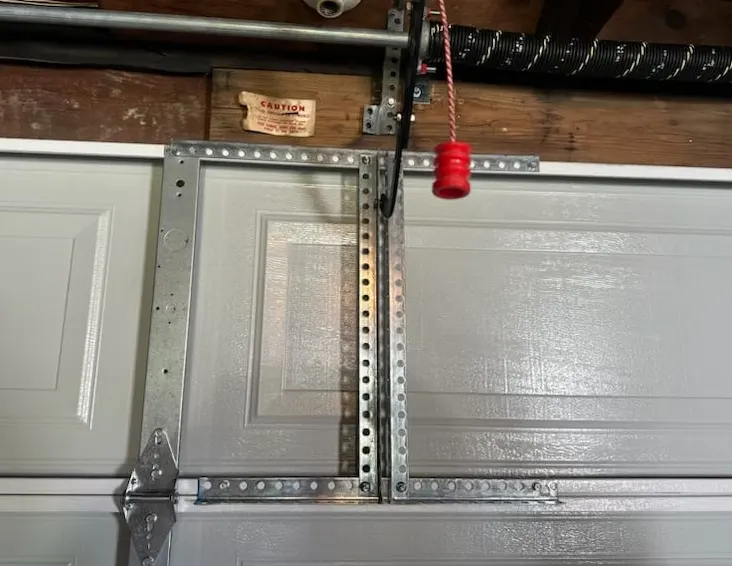
On a typical service call in this area, a technician usually finds the same thing: a ten- to fourteen-year-old opener that's started grinding partway through its cycle, skipping the occasional remote signal, or refusing to fully close on humid afternoons after a downpour. The homeowner wants to know one thing — is this worth fixing again, or should the whole unit go? The honest answer depends less on the age printed on a sticker and more on what's failing and how often.
What Usually Fails First
In this climate, the parts that give out earliest are rarely the big, obvious ones. More often it's:
- The circuit board, where moisture and salt air corrode contacts and cause intermittent failures
- The capacitor, which weakens under sustained heat and eventually won't push the motor through a full cycle
- The drive gear or chain, worn from years of swelling wood doors catching slightly on the track
- Sensor alignment, knocked off by humidity-swollen door panels or accidental bumps
Any one of these is a reasonable repair. Two or three showing up within a year or two is a different story.
The Repair Side of the Ledger
A single-issue repair — a new circuit board, a logic board reset, sensor realignment, or a capacitor swap — typically runs in the range of national averages for opener repairs, often well under the cost of a new unit. If the opener is otherwise sound, has a working chain or belt, and this is its first real issue, repair is the obvious move. You keep a unit that's already proven it can handle the heat and humidity cycle, and you spend a fraction of what replacement costs.
The trade-off: repairs on an aging unit are rarely isolated. Fix the board this year, and the capacitor or the motor bearing is often next, especially once a unit has been through several hurricane seasons of humidity swings and power surges from storms.
The Replacement Side of the Ledger
A new opener costs more upfront — national ranges for a quality residential unit with installation land solidly above what most single repairs cost. But it resets the clock: new capacitor, new board, better surge tolerance, and often a battery backup option, which matters here when storms knock out power and you still need to get the car out. Many newer units also handle humidity-related sensor drift better than models from a decade ago.
The trade-off: if the door itself, the springs, or the track are also aging, a new opener paired with components that are still wearing down won't perform as well as it should — you're putting a new engine in a car with bad brakes.
Side-by-Side: The Five-Year Picture
Picture two homeowners with similar openers, both around the ten-year mark:
- Homeowner A repairs each failure as it happens. One board replacement now, likely a capacitor or sensor fix in a year or two, maybe a second board issue by year four. Total cost over five years often approaches or exceeds the price of a new unit, with downtime and inconvenience at the least convenient moments — usually during a storm.
- Homeowner B replaces now. Higher cost today, but no major opener expense expected for the next five-plus years, plus the benefit of surge protection and backup power from day one.
The math tips toward replacement once a homeowner has already paid for two separate repairs, or once the opener is past the ten-to-twelve-year mark and showing more than one symptom at a time.
The Local Factors That Tip the Decision
A few things specific to this region push the decision one way or the other:
- Salt air exposure near the coast accelerates corrosion on boards and metal components, shortening the useful life of repairs
- Storm-season power surges are harder on older circuit boards that have already been patched once
- Humidity-swollen doors put extra strain on drive systems, so a repaired opener paired with a door that isn't moving freely will keep failing regardless of what's fixed
Our Recommendation for Typical Homes Here
If this is the opener's first real issue and the door itself moves smoothly, repair it — there's no reason to replace a unit that's otherwise healthy. If you've already repaired it once in the past year, or it's past the decade mark and multiple symptoms are showing up together, replacement is the cheaper path over five years, not just the more convenient one.
When to Call Sunrise Garage Door
If your opener is acting up — slow response, grinding, a door that won't fully close, or remotes that work only sometimes — call before the small issue becomes a stranded car during the next storm. We handle both garage door opener repair and full opener installation, and we'll tell you honestly which side of that five-year math your unit falls on before any work starts.
Give Sunrise Garage Door a call today to get your opener checked out before the next round of storms rolls through.